
Meetings get added. They never get taken away.
It starts small. Something goes wrong, so a meeting gets added. A few years later the management team meets on Monday, the team leaders on Tuesday and the project group on Wednesday. And the decision gets made on Thursday, by the coffee machine.
Structure is the part of an organisation you can draw: who has which role, who decides what, which meeting is for what and how often it meets. It sounds dry. It does decide where everyone’s week goes.
Almost three working days a week.
That is how much time managers spend in meetings on average: almost 23 hours a week, compared with fewer than ten in the 1960s. Leslie Perlow, Constance Noonan Hadley and Eunice Eun wrote this in Harvard Business Review in 2017.
Their conversations with hundreds of managers also showed that one-off tricks don’t help much. A shorter meeting or a tighter agenda just moves the problem. What works is taking a fresh look at the whole rhythm of meetings, together with the people who sit in them.
Who decides on this?
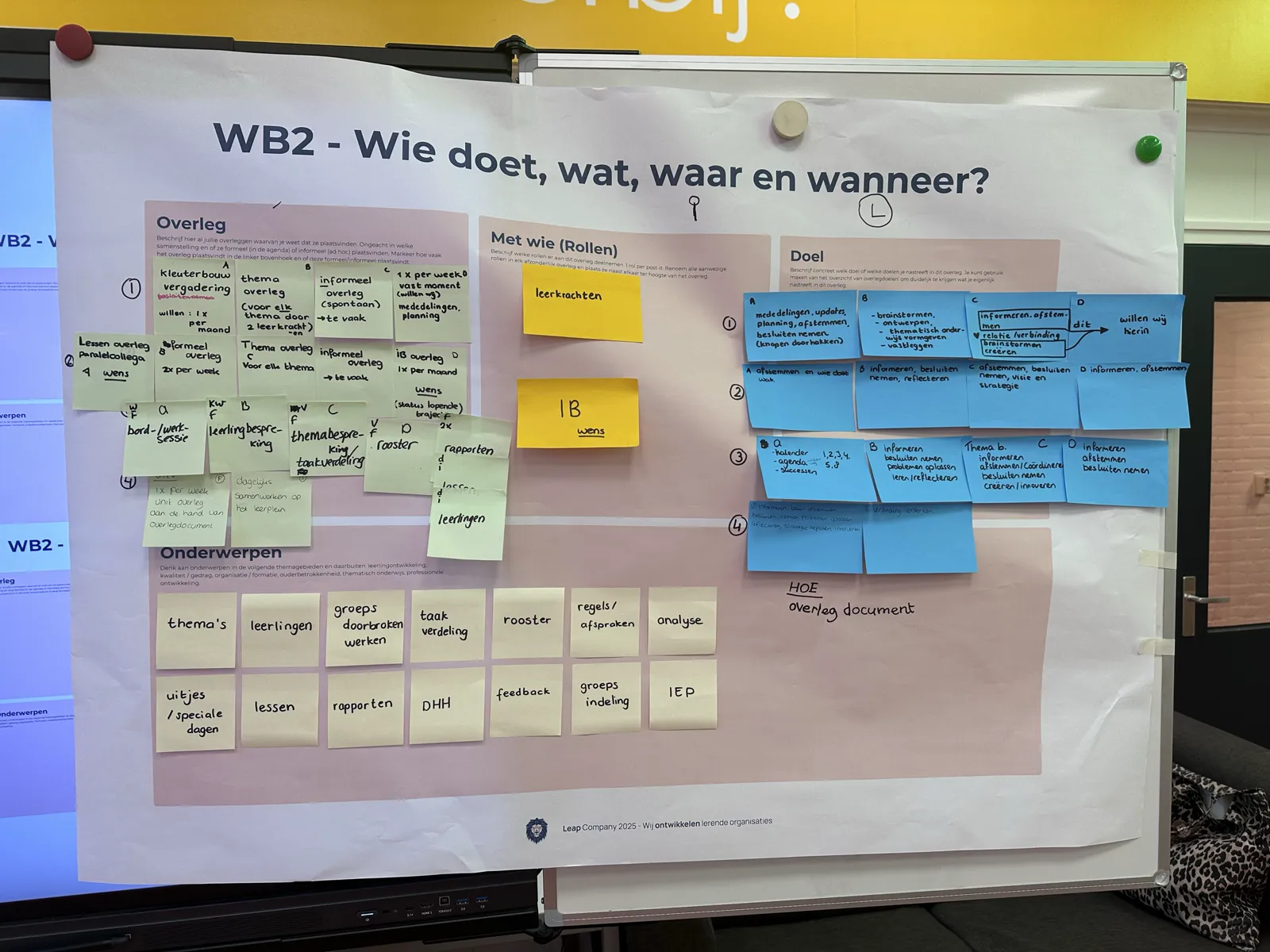
That is the question we ask most, and the answer almost always differs from person to person. With the Governance app, every team member fills in who is responsible for the most important topics. Then we put the answers side by side. Where the pictures differ, that’s where the friction is. “Don’t know” counts as an answer too: if nobody in a team knows who is responsible for something, that is a finding in itself.
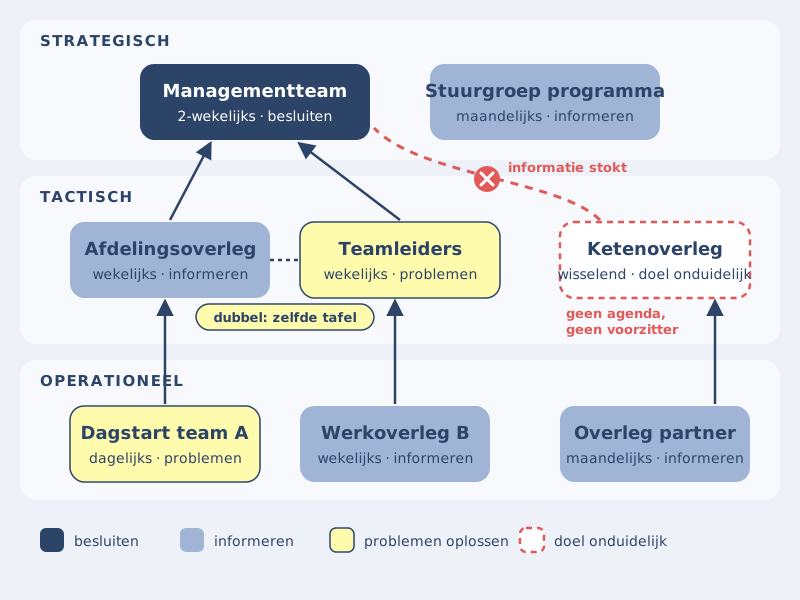
Then we design the rhythm together. Which meetings are there to steer and which to get the work done, who sits in them, and what comes out of them. We write roles and mandates down in plain language, so that a new colleague understands them too.
If you want to steer, you also need to see what is running. That is why we often set up portfolio management and capacity management: one list of all initiatives, what is running each quarter and how much time it takes, and each week whether the team can handle it. On the services page you can see how a spreadsheet like that fills up.
Questions we often get
What does a good meeting structure look like?
One in which every meeting has a single purpose and produces something, a decision or an action. A meeting that never produces anything can go. Put all your meetings side by side and you’ll quickly see where they overlap and which decisions fall through the cracks.
What is a mandate?
The room to make decisions yourself, within agreements that are clear in advance. A mandate only works once it is written down and everyone has the same picture of it. That second part is rarely the case. So we measure it first.
Should you tackle structure first, or culture?
Both at the same time. Changing only the structure is like putting on one shoe. And behaviour that looks like culture, such as waiting to see what happens, often comes from nobody knowing exactly who decides what.
From our blog
Short pieces from practice. They open on the blog.
Look where you want to go: the F1 strategy that makes your organisation faster than the rest
Stare at the wall and you'll hit it. On target fixation in organisations, and why as a leader you aim for the apex: the future you want.
· 4 min read
Structure as the foundation of team culture: how to build safety, focus and collaboration
An open, safe team culture starts with agreements, rhythm and clear roles. On structure and team friction, feedback, job satisfaction and a new manager.
· 5 min read
From vision to behaviour: how to bring your plans to life
A vision on a poster doesn't change anyone's Tuesday. How to turn strategy, core values and ambitions into behaviour that sticks in teams.
· 4 min read
Sources
- Perlow, L. A., Hadley, C. N., & Eun, E. (2017). Stop the meeting madness. Harvard Business Review, July–August 2017. hbr.org/2017/07/stop-the-meeting-madness