
Psychological safety
Psychological safety is the shared sense in a team that you can raise a question, a mistake or a dissenting view without it being held against you. It is one of the best-researched predictors of how well teams learn and perform.
Safe means you ask the awkward question.
In 1999, Amy Edmondson of Harvard Business School described psychological safety as a shared belief in a team that it is safe to take interpersonal risks there. It comes down to small moments. The new colleague who asks how something works. The nurse who has doubts about a dose. The team leader who says her own plan isn’t working.
It is often mistaken for being cosy, or for going easy on each other. Edmondson warns against that herself. A safe team can set high standards, and that is exactly when it needs the safety most. People who have to perform at a high level and don’t dare say anything make mistakes nobody sees.
The best wards reported the most mistakes.
Edmondson noticed this in her first study in hospitals. Wards with a better team climate and better leadership reported more medication errors. Her explanation: people there dared to report them. On the other wards the errors happened too. Nobody saw them.
In 1999 she followed 51 teams in a manufacturing company. Teams with more psychological safety showed more learning behaviour: asking questions, asking for feedback, talking about mistakes. And through that learning behaviour, they performed better.
Years later, Google reached the same conclusion. In Project Aristotle the company studied hundreds of its own teams. Of the five things that set good teams apart, psychological safety mattered most. A 2017 review by Frazier and colleagues, based on 136 studies covering more than 22,000 people, links safety with sharing information and learning, and through those with performance and engagement.
Safety grows on agreements.
Psychological safety sounds soft. In our work it often starts with something hard: knowing who decides what, when you can raise a concern and what happens to it next. Where that is unclear, people keep their mouths shut. If you don’t know the rules of the game, you play it safe.
Edmondson saw this back in 1999: support from the organisation and coaching by the team leader help determine how safe a team feels. At Google, structure and clarity were on the same list of five.
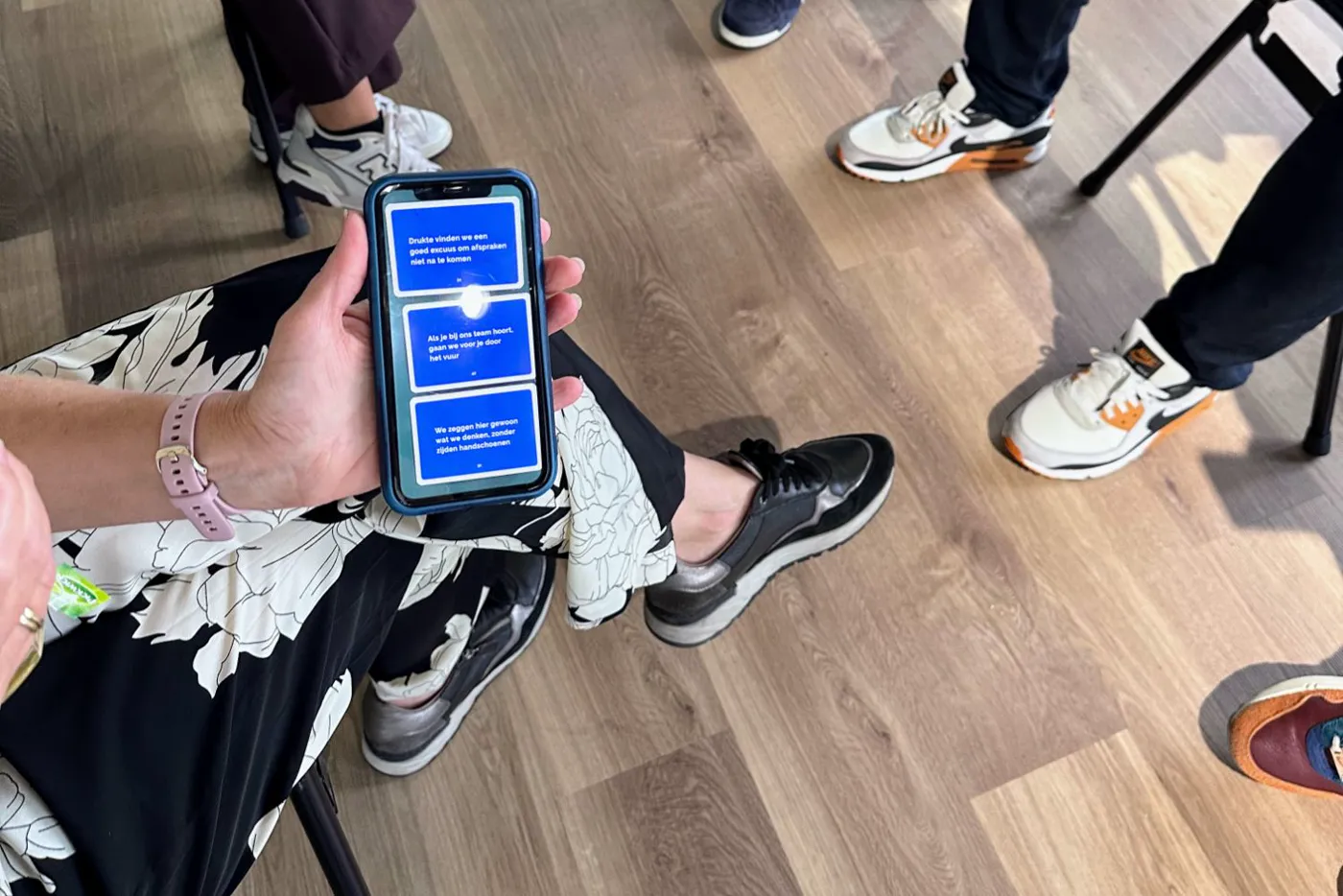
So we work on both sides at once. The conversation about the unwritten rules, and the agreements that make that conversation safe. After one of these sessions, a team agreed that if something gets to you, you go to the other person, not to the manager. A sentence like that does more than a poster of core values.
Appreciative inquiry
Appreciative inquiry is a way of changing that starts with what already works. Together you look for the moments when the team was at its best, and build from there.
You find what you look for.
Every evaluation starts by asking what went wrong. Every improvement programme starts with a list of bottlenecks. After a few years, an organisation like that is very good at analysing its mistakes and can barely say what it does well.
In 1987, David Cooperrider and Suresh Srivastva turned that around. Their starting point: an organisation moves in the direction of the questions it asks. Ask what goes wrong and you get a longer list of problems. Ask about the moments when it worked, and you discover what you want more of.
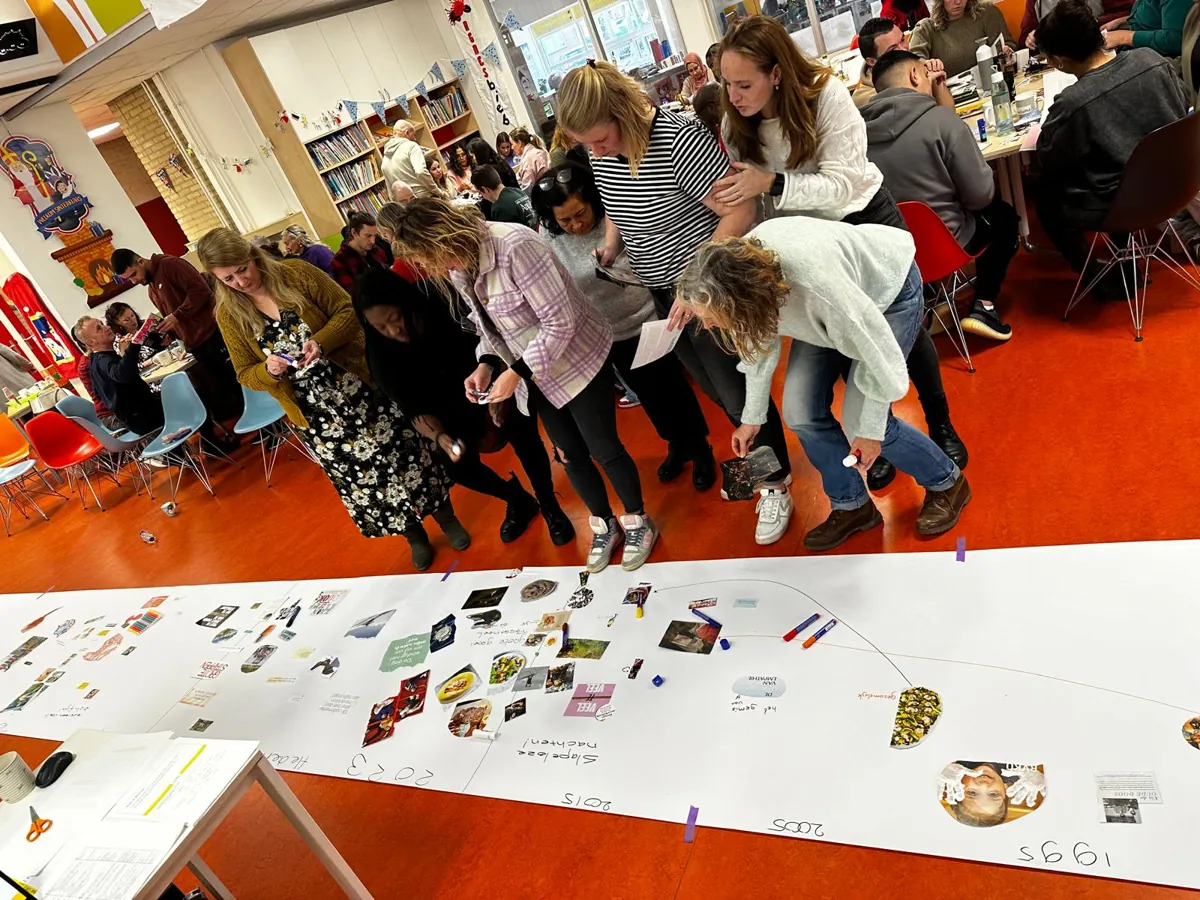
That sounds soft. In practice it is a tightly organised inquiry, in which people interview each other, collect stories and look for patterns in them together. The participants are the researchers.
Seven out of twenty.
In 2005, Gervase Bushe and Aniq Kassam compared twenty published appreciative inquiry projects. All twenty followed the method to the letter. In seven of them, something really changed in the organisation.
The difference came down to two things. The successful projects were about how people looked at their work, and less about what they had to do. And after the event, people got room to take up initiatives themselves, instead of an action list rolled out from the top.
Barbara Fredrickson’s broaden-and-build theory explains why an appreciative start produces more ideas: positive emotions widen what people see and dare to try. Someone who has just told the story of their best day at work thinks more broadly than someone who has just worked through a list of bottlenecks.
An appreciative day is easy to organise.
Whether anything changes afterwards depends on what happens in the weeks that follow. That is why we work in five steps rather than one day. The last of the five is the hardest, and we don’t leave it to chance.
- DiscoverWhen was this team at its best, and what made that possible?
- DreamWhat does it look like when that becomes business as usual?
- DesignWhich agreements, roles and meetings go with it?
- DeliverWhat are we going to do tomorrow, and who is picking it up?
- EmbedHow do we make it stick once the day is over?
In the deliver step we stick to what Bushe and Kassam found: people pick up what gives them energy. In the embed step the structure comes in, with a fixed place in the meeting cycle and someone who keeps coming back to it. Without that second step, the enthusiasm is gone within three weeks.
Questions we often get
Is psychological safety the same as trust?
The two are close. Trust is about how you judge someone else. Psychological safety is about the climate in a team: what happens here when someone speaks up. You can trust your colleague and still keep quiet in the meeting.
Does a safe team mean anything goes?
No. Edmondson puts safety alongside accountability. A team with plenty of safety and a low bar is comfortable. A team with a high bar and little safety is anxious. Learning happens where both are high.
How do you measure psychological safety?
Edmondson developed a short questionnaire of seven statements, such as “If you make a mistake on this team, it is often held against you.” Look at the average, and even more at the spread. If half the team feels safe and the other half doesn’t, you know where the conversation needs to start.
What can a manager do as soon as tomorrow?
Open the next meeting with something you wish you had done differently yourself. Then ask a question you genuinely don’t know the answer to, and wait. When someone brings bad news, thank them for raising it, even when the timing is awkward.
Isn’t appreciative inquiry a bit too positive?
Problems still get put on the table. You just talk about them in terms of what you want instead of what you don’t. “Nothing ever gets decided here” becomes “When did we last make a good decision quickly, and what was different then?” Same problem, different way in.
How is it different from an away day?
An away day is a day. Appreciative inquiry is a cycle, and the day is one step in it. The real work is in collecting the stories beforehand, and in what people do with them afterwards.
Does it work in a team with a lot of friction?
Often that is exactly when it works, because nobody is keen on yet another analysis of what is going wrong. If trust has gone completely, we start with a different conversation first: about what happened, before you can look ahead together.
Where does appreciative inquiry come from?
David Cooperrider and Suresh Srivastva described it in 1987 at Case Western Reserve University. Cooperrider and Diana Whitney later developed it into the 4-D cycle of discovery, dream, design and destiny. Our five steps (the “five V’s” in Dutch) are our own version of it.
From our blog
Short pieces from practice. They open on the blog.
Working across organisational boundaries: why stakeholder management works
Working across organisations only works once you know what matters to each party. On stakeholder management, psychological safety and governance.
· 6 min read
But how? Team agreements that actually stick
How to make team agreements that stick: specific, made by the team itself and doable. Four ground rules for your team meeting or away day.
· 1 min read
Agile: where leaders make the difference
Agile and SAFe succeed or fail on leadership, structure and behaviour, and another tool won't fix that. What you as a leader can do differently today.
· 3 min read
Sources
Psychological safety
- Edmondson, A. C. (1996). Learning from mistakes is easier said than done: Group and organizational influences on the detection and correction of human error. The Journal of Applied Behavioral Science, 32(1), 5–28. doi.org/10.1177/0021886396321001
- Edmondson, A. C. (1999). Psychological safety and learning behavior in work teams. Administrative Science Quarterly, 44(2), 350–383. doi.org/10.2307/2666999
- Edmondson, A. C., & Lei, Z. (2014). Psychological safety: The history, renaissance, and future of an interpersonal construct. Annual Review of Organizational Psychology and Organizational Behavior, 1, 23–43. doi.org/10.1146/annurev-orgpsych-031413-091305
- Frazier, M. L., Fainshmidt, S., Klinger, R. L., Pezeshkan, A., & Vracheva, V. (2017). Psychological safety: A meta-analytic review and extension. Personnel Psychology, 70(1), 113–165. doi.org/10.1111/peps.12183
- Google re:Work. Understand team effectiveness (Project Aristotle). rework.withgoogle.com/intl/en/guides/understand-team-effectiveness
- Edmondson, A. C. (2018). The fearless organization. Hoboken: Wiley.
Appreciative inquiry
- Cooperrider, D. L., & Srivastva, S. (1987). Appreciative inquiry in organizational life. In R. W. Woodman & W. A. Pasmore (Eds.), Research in organizational change and development (Vol. 1, pp. 129–169). Greenwich: JAI Press.
- Cooperrider, D. L., & Whitney, D. (2005). Appreciative inquiry: A positive revolution in change. San Francisco: Berrett-Koehler.
- Bushe, G. R., & Kassam, A. F. (2005). When is appreciative inquiry transformational? A meta-case analysis. The Journal of Applied Behavioral Science, 41(2), 161–181. doi.org/10.1177/0021886304270337
- Fredrickson, B. L. (2001). The role of positive emotions in positive psychology: The broaden-and-build theory of positive emotions. American Psychologist, 56(3), 218–226. doi.org/10.1037/0003-066X.56.3.218