

Whose call is this?
Everyone in the organisation has an answer to that question, just not the same one. With our Governance approach and the app we built for it, we show where views differ. Then, together, we reach agreements that everyone knows about.
What we mean by governance.
Governance is how responsibilities and authority are divided within an organisation: who owns a topic, who advises, who decides, who records it and who needs to hear about it. On paper, that is set out in a delegation scheme or an organisation chart. In practice, it works the way people think it has been arranged.
That perception is what we measure. Where the answers match, there is little to sort out. Where they differ, you find the conversation that needs to be had.
When to use it.
When people disagree about who is responsible for what. You notice it in decisions that are taken twice or not at all, in topics that go back and forth between teams, and in the question "whose call is this?" coming up in every meeting.
Within the organisation
- Merging departments
Two ways of working become one. What belongs to whom now?
For example: Two customer service teams after a merger: who can agree to a payment plan?
- Growth or a new way of managing
What used to happen by itself now has to be assigned to someone. Or teams get more authority, and nobody knows how much.
For example: A company grows from 40 to 150 people, and the founders can no longer decide on everything.
- Between departments
Work that crosses department boundaries and gets stuck there.
For example: Sales promises a delivery time that logistics cannot meet.
- Data and systems
Everyone works with the same data. Who can change it, and who is accountable when it is wrong?
For example: Who owns the customer data: IT, marketing or sales?
With several parties
- Projects and programmes with several parties
Everyone contributes something. Who decides when interests clash?
For example: Building a heat network with the municipality, the grid operator and a housing association.
- Partnerships
Partners who each have their own board and their own mandates, and one shared assignment.
For example: Municipalities in a region that jointly commission youth care.
- Working along a chain
With internal parties, external parties or both. Each organisation in the chain answers from its own perspective.
For example: From hospital to home care: who coordinates when a patient is discharged?
How it works.
A four-step process, repeated when needed. The app collects the answers and shows where they differ. We have the conversation about it with you.
The film shows the whole process in just over a minute, with a municipality and a wholesaler as examples. Below it you can read what happens at each step and what you see in the app.
- Mapping
Where do views differ?
Together we map the themes and topics people disagree on: who owns something, who can decide on it, or who is supposed to do which tasks. You put forward topics, and so can the participants. That way the list is built from the top down and from the bottom up.
- Answering
Everyone answers at their own pace.
We invite the participants. Everyone answers the same seven questions for each topic, in their own time and without seeing anyone else's answers. "I don’t know" is an answer too: if nobody knows who is responsible for something, that is a finding in itself.
- Ownership Who owns it from start to finish?
- Advising Who has an advisory role?
- Decision-making Who has the mandate to take the decision?
- Documentation Who documents it?
- Stakeholders Who must be consulted beforehand?
- Communication Who communicates the decision, and to whom?
- Escalation Who do you escalate to?
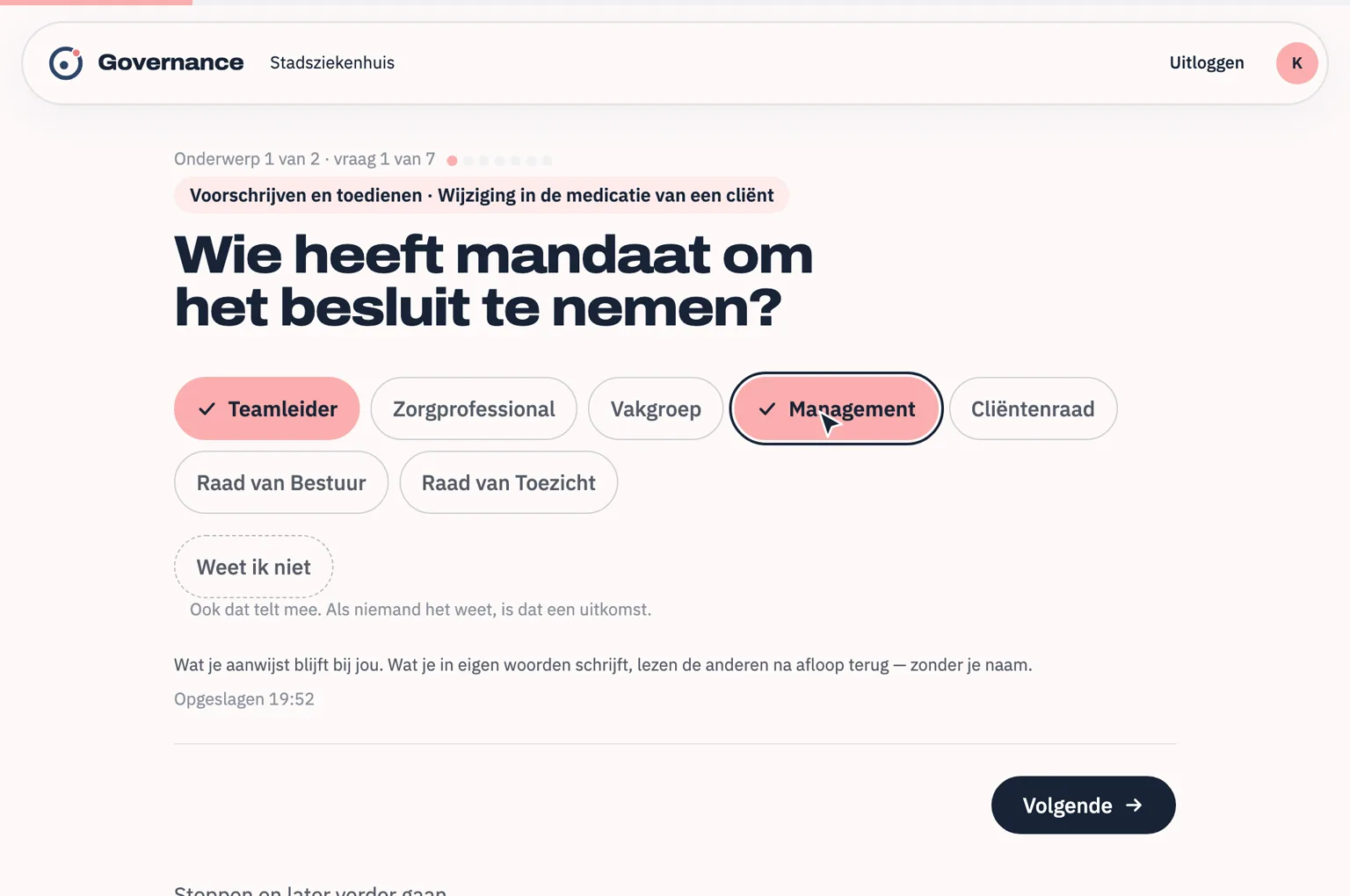
One question per screen, with the roles of your own organisation. Screenshot in Dutch. - Analysing
Where do people agree, and where don’t they?
As soon as everyone has answered, the app puts the answers side by side for each topic and each question. We analyse the responses: which topics have broad agreement, and which are disputed? The second group is where it gets interesting.
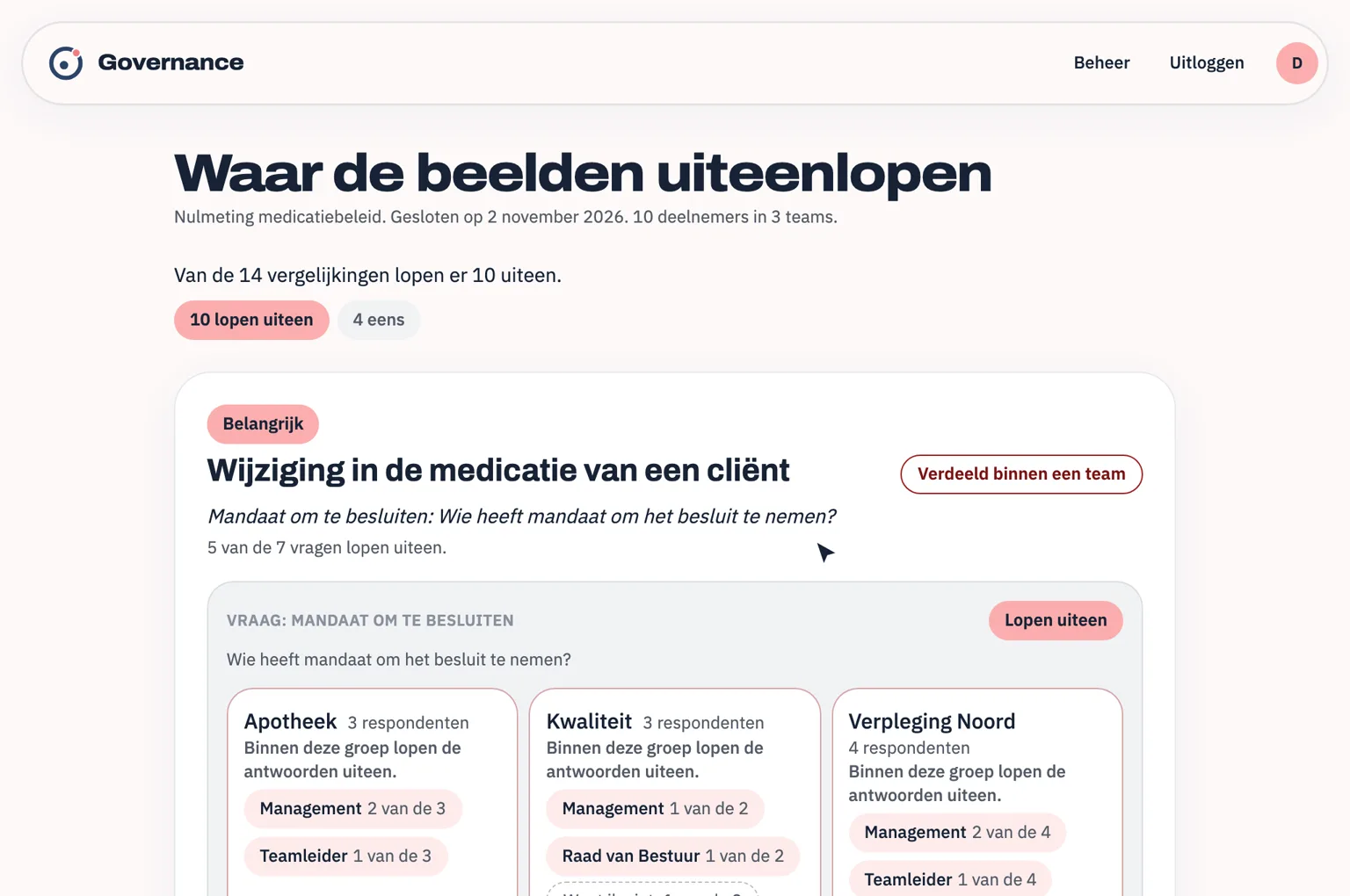
The results: for each question and each team, where the answers match and where they differ. Screenshot in Dutch. - Meeting
Talking through the differences.
We discuss the topics people disagree on in a session we facilitate, with the aim of reaching agreement on those too. Where things turned out to be right already, we say so out loud, so participants see that their answers counted.
The outcome: every responsibility has an owner, and everyone knows how it works and with whom.
Emergency placement of a resident
- Owner
- Neighbourhood team
- Decision
- Municipal neighbourhood coordinator
- Consulted beforehand
- Care provider
- Communicates
- Neighbourhood coordinator, to the care provider and the resident
- Escalation to
- Neighbourhood team manager
This is what a recorded agreement looks like, from the public-sector example in the film. Fictional. - Checking back
Six months later: does it still hold?
In practice, new topics come up, or things turn out differently from what was agreed. Then we send out the same questions again and reopen the conversation. You see what has shifted since last time, and the agreements grow with the organisation.
What you get.
The conversation focuses on the differences
What everyone already agrees on doesn’t need discussing again. The meeting spends its time on the topics where views differ.
Everyone gets a say
Including the people who stay quiet in meetings. Because answers are shielded, people say what they think, not what their manager wants to hear.
No extra meetings just to gather input
Participants answer in their own time. You don’t need everyone in one room at once to know where things stand.
Decisions no longer get stuck
Once it is clear who owns something and who decides, the back and forth between teams stops, and so does work that gets done twice, or not at all.
It has to be safe to answer honestly.
If you can see what the director filled in first, you fill in something else. And disagreeing with your manager shouldn’t get you into trouble later. That is why colleagues and your manager can’t see your answers. Once the survey closes, you only see numbers per team, and teams with fewer than three answers stay hidden, so nobody can trace who said what.
Read the app FAQ, or how we handle privacy and security (all in Dutch).
What we learn across all the surveys.
Each survey shows which topics cause disagreement and how decision-making works in practice. With the organisation’s permission, we store those results anonymously, so we can do research across sectors. Which topics cause friction in education, and which in healthcare?
That makes it a complement to Leap Trends. Trends follows what is published about organisations; this shows what happens inside them. For anyone who wants a better understanding of how organisations work.
Sound familiar?
We’ll show you the app and help you work out which topics to include in the survey.