From understanding to action.
A new structure, a leadership course or more ownership? Maybe. But first we want to understand what is going on. What do you want to achieve as an organisation, what is standing in the way, and how do behaviour, structure and technology affect each other?
The three reinforce each other: insight without the right set-up goes nowhere, and a new structure without the people on board doesn’t work.
Highlighted: the examples for this area of expertise.
No off-the-shelf solutions. Just a good start.
You can come to us for organisational advice, team development, leadership programmes, workshops and more. But we won’t open by selling you one of them.
First we want to hear your question. What is going on? What do you want to achieve? And what will it take to get there?
It doesn’t have to be big or complicated. Sometimes one focused workshop, a good conversation or a small change in how people work makes a big difference. Sometimes the issue calls for a longer programme. And sometimes it is wise to start small and build from there.
We think critically and creatively about what is needed and what suits your organisation, your ambitions and what is feasible right now. Tell us what is going on, and we will think it through with you.
We can help with
- Organisational advice
- Team development
- Leadership programmes
- Workshops
- And much more
Why we look at the whole picture.
An organisation never develops in just one place.
What people do, how the work is organised and which technology they use constantly affect each other. Change one and you change another. That is why we look at how those parts together serve the organisation’s goals, and where they get in each other’s way. Our Leapshift model makes those connections visible and helps pinpoint where development is needed.
Explore the modelWhat we do in practice.
No two organisational issues are alike, so we don’t work with standard solutions. We look at what is going on, what you want to achieve and what that takes.
That might mean organising processes more smartly, developing leadership, improving decision-making or helping teams work together better. Often it takes a combination, because structure, culture and technology affect each other.
Take decision-making as an example. Clear roles and mandates matter, but without the trust and leadership to use that room, little changes. Technology can speed up processes, but only when people are able and willing to work with it. That is why we choose interventions that reinforce each other, on the scale the issue calls for.
What we do in practice
Dig deep
Understanding what is going on before we think about solutions.
The question you bring to us is not always the real issue. A meeting that gets stuck, a team that doesn’t work well together, a change that never quite gets off the ground. We look at what lies behind it. What does the organisation want to achieve, what is holding it back, and how are the causes connected?
Using our organisational model as a lens, we look at the whole: the goals, the culture, the structure, the technology and the leadership. Our own tools quickly gather different perspectives, reveal connections and show where things rub. That way we get to the heart of the matter faster and have more time for the conversation that counts.
Digging deep also means saying what we see, even when it is not what you originally asked. We look at what is needed and at what is possible and sensible right now. Sometimes that calls for a bigger change; sometimes a focused first step is wiser.
How we have tackled this before
Click an example to see how we tackled it, what it delivered and what it takes.
Organisational diagnosis and development researchIt starts with a good conversation: an hour and a half to two hours at the table with the people facing the challenge. Where needed, an organisational diagnosis follows.
Getting to know each other in an intake conversation is always an important starting point for us. We take the time to get to know you and your organisation, and to understand properly what is going on, and where. We listen, ask follow-up questions and note what strikes us.
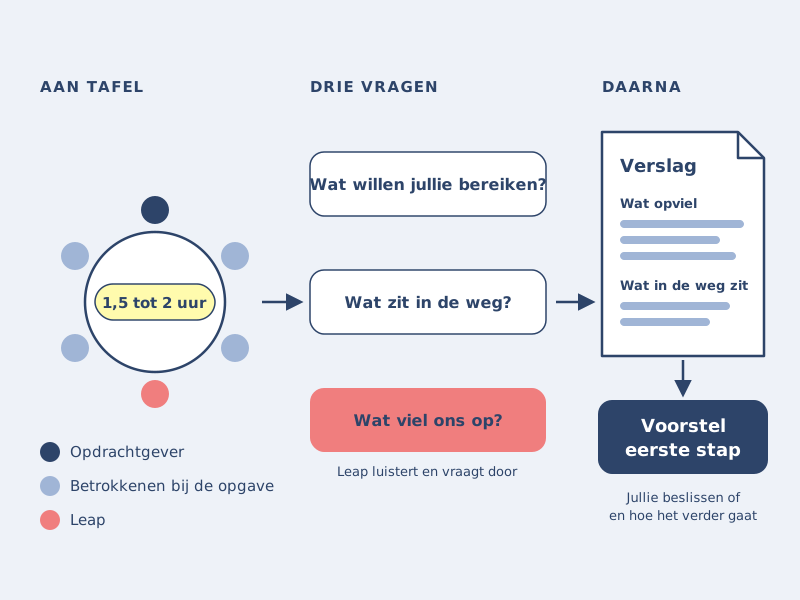
How do we do that? We sit down with the client and the people facing the challenge, at your offices or online. We want to hear what you want to achieve and what is getting in the way, and we keep asking until we understand.
Afterwards we share a report: what we discussed, what struck us and a proposal for a first step.
Where the issue calls for it, an organisational diagnosis or a development study follows. Then we look wider and deeper: with interviews and observations, with our own scans, and with the organisational model as a lens on the goals, the structure, the culture, the technology and the leadership.
When this helps
When something is wrong and you can’t yet put your finger on it, or when you want to find out whether we are the right fit before you commit to anything.
What you get
- A shared picture of the question
- A report with what struck us
- A proposal for a first step
What it takes
An hour and a half to two hours with the people facing the challenge.
Interviews, observations and interactive analysisWe gather perspectives from across the organisation, from the boardroom to the shop floor, and analyse together what we see.
We want the whole organisation at the table. Talk to three managers and you hear one perspective. The real insight lies in everyone’s view of what works and what doesn’t.
We talk to people in different parts of the organisation, watch the work and the meetings first-hand, and analyse what we see in interactive sessions with the people themselves. Our own tools quickly gather different perspectives, reveal connections and show where things rub.
When this helps
When views differ on what is going on, or when you want to know how things really work on the shop floor.
Background: Appreciative inquiry
Mapping processes and information flowsSee in black and white where time and money are leaking away. Together with the people who do the work, we map how the work really flows, and through which systems. That shows where it stalls, gets done twice or falls through the cracks.
In practiceFor a telecoms and infrastructure company we mapped the main IT processes, including waiting times, waste and current lead times. Combined with a map of the technology landscape, this made clear which additional technology we could use when redesigning the processes.
We draw the process together with the people who do the work, step by step, as it really runs today. For each step we note how much time the work takes, how long it then sits waiting and what goes wrong.
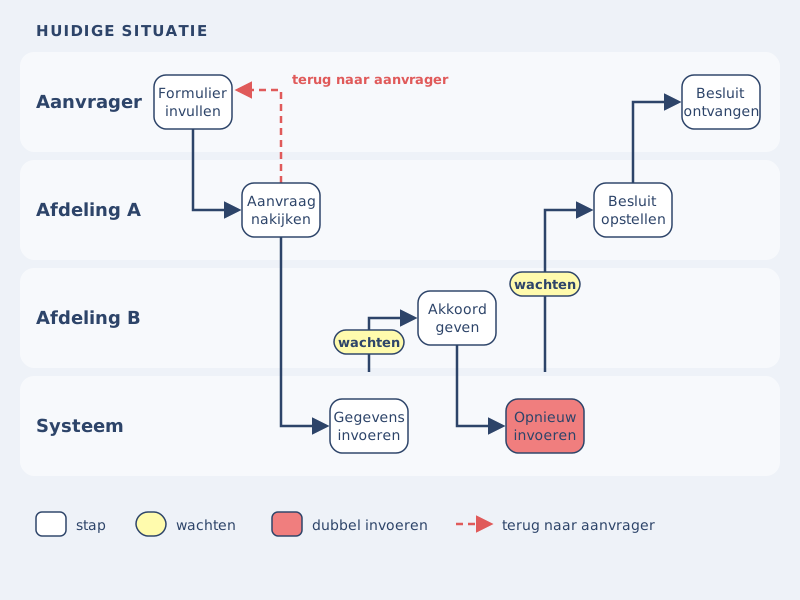
We often start with what the systems already know. We export the existing processes from, say, an HR system and analyse them, with the help of AI: how much is manual work and where could you automate, how often does something go wrong, and how much rework does the process involve?
Then we mark the waste: double entry, waiting, rework and handovers. And we count: how often does this happen each year, and what does it cost?
Which systems are there, who uses them for what, and where do they overlap or leave gaps? A clear overview as the basis for technology choices.
We start with the people who work with the systems: employees, managers and the teams that manage the systems. For each system we record what it is for, who has access to it, who owns it and what data it exchanges with other systems.
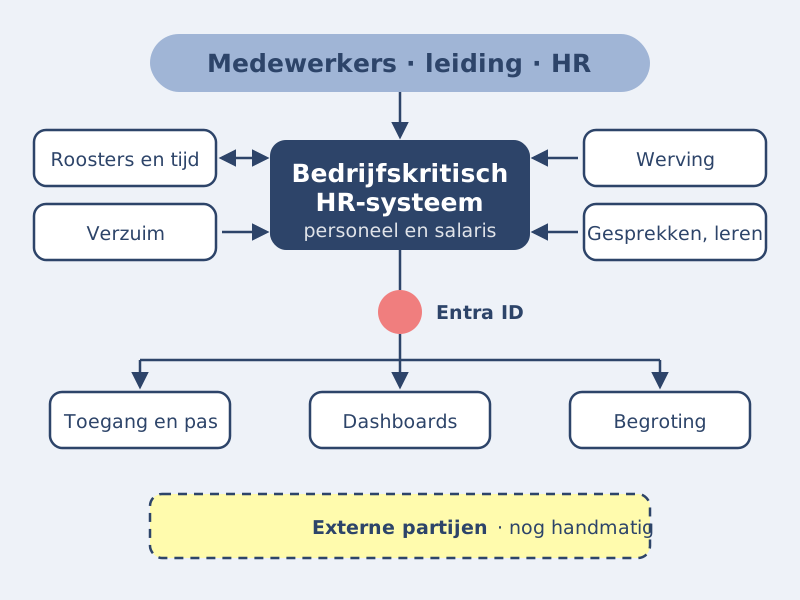
We bring this together in one picture of the whole landscape, with a short explanation per domain and an overview of who manages and owns what. That shows where data is entered twice, where a link is missing and where work is still done by hand.
For HR we mapped more than twenty systems this way, from rosters and absence to budgets and dashboards.
When this helps
When work takes a long time to get through although everyone is busy, or when there is a lot of retyping, checking back and correcting. Mapping the IT landscape also shows you who owns what, and where nobody does. Missing tasks and responsibilities can then be clearly assigned.
What you get
- The process as it runs now, with time and waiting time per step
- The waste marked and counted
- One picture of the whole landscape
- Per domain: function, access, management and links
- An overview of who is responsible for what
Background: Process optimisation
Examining roles, mandates and decision-makingA shared picture of who decides what and where that causes friction, so that decisions are made where they belong again.
The reasons vary. Teams are being merged. People have to work together in a chain with a supplier, customers or other external parties. Or departments and parts of the organisation work together in an internal chain, and the shared picture of that collaboration has yet to be designed.
We start with interviews and an analysis of what has already been written down about governance. In practice our Governance app is the starting point: it speeds up the research and makes the picture a shared one.
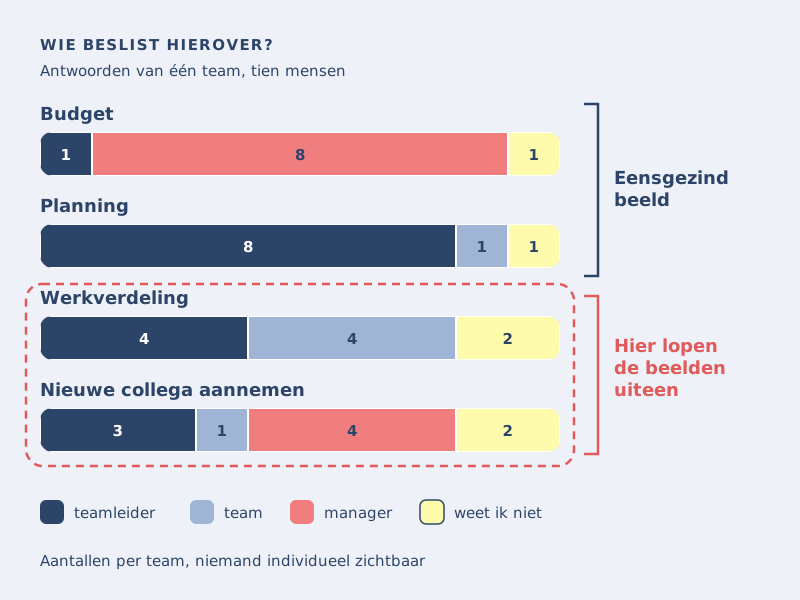
Together we choose the topics that matter. For each topic everyone answers seven questions: who owns it until it is completed, who advises, who has the mandate to decide, who must be consulted beforehand, who records it, who communicates the decision and to whom, and when do you escalate? Colleagues and managers cannot see each other’s answers.
Once the survey closes, you see for each topic where views agree and where they differ, in numbers per team. "Don’t know" counts too: if nobody knows who is responsible for something, that is a finding in itself.
When this helps
When teams are being merged, when people work together in a chain, within the organisation or with suppliers, customers and other parties, or when decisions stall or keep landing on the same desk.
What you get
- Per topic, a view of who thinks who decides what
- The places where views differ
- A conversation based on answers instead of impressions
Background: Structure
Using our own scans and digital tools to reveal patternsShows how vision and goals play out in the organisation, how teams work together and how structure and technology help. The basis for our advice.
The digital scan is in development.
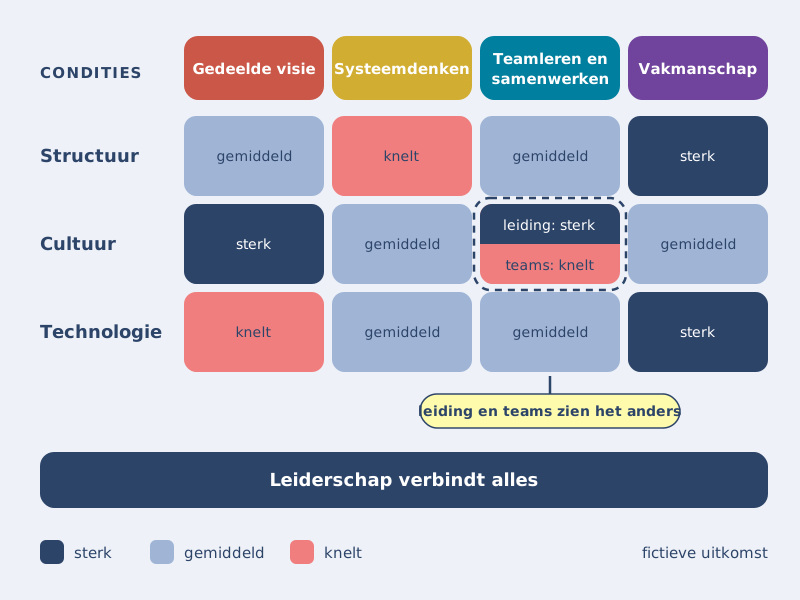
Employees and managers fill in a short questionnaire on the four domains of the model: shared vision, systems thinking, team learning and collaboration, and craftsmanship. For each domain we look at how structure, culture and technology help or get in the way.
The result shows for each team where things are strong and where they rub, and where management and teams see things differently. We discuss those differences in a feedback session with the client and, where it makes sense, with the teams themselves.
That is what we base our advice on: where to start, and what is better left for now.
Besides Leapshift we use the Governance app and ESCI 360. You can read more about them on our tools page.
When this helps
When you want to know where you stand before you choose what to tackle, or when a change isn’t landing and nobody knows exactly why.
What you get
- A picture per team, across the four domains and the three conditions
- A view of where management and teams see things differently
- A feedback session with the client
- Advice on where to start
Background: Our tools
What we do in practice
Organise smart
Setting up the organisation so that ambitions, people and resources fit together.
We help organisations work smarter and more effectively, from how work is divided within a team to how the whole organisation is set up and run. We take a critical look at how the work is organised. Are roles and responsibilities clear? Are decisions made in the right place? And do ambitions, priorities and available capacity match?
Organising smart also means being critical about what is really needed. A new meeting, an extra procedure or a more complicated structure for every issue makes the work heavier. We look for solutions that reduce complexity and create room, and we make deliberate choices about what you organise centrally, what you put elsewhere and what you can drop.
Technology is a natural part of this. We use what is already there, automate where it adds value and build smart tools ourselves.
How we have tackled this before
Click an example to see how we tackled it, what it delivered and what it takes.
Setting up governance and decision-makingOne room, physical or digital, where goals, progress and bottlenecks are visible. That way you steer together on what matters.
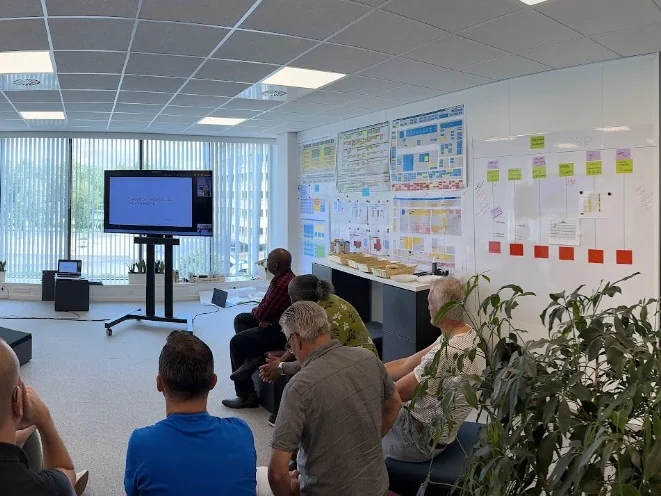
Obeya is Japanese for big room. Toyota used such a room to make everything that mattered visible in one place. We start with the question of what you want to steer on: which goals have been set for this year, which projects should contribute to them, and which figures show you whether it is working? That determines how the walls are laid out.
Then we set up the room, usually in four parts: the direction and the goals, the progress of projects and improvement actions, the figures that matter every week, and a board with bottlenecks and actions. For each wall we agree who keeps it up to date.
Then the rhythm. Every week at the same time, a short stand-up meeting at the wall. You walk past the walls, discuss only what is red and agree who picks up each bottleneck. Anyone working remotely joins on screen.
In the first weeks we take part and fine-tune. What nobody uses comes off; what is missing goes up. After that the team runs the Obeya itself.
When this helps
When a lot is going on at once and nobody has the overview, or when meetings are mostly about status updates and too little about what is needed.
What you get
- One place where goals, progress and bottlenecks are visible
- A short, regular meeting about bottlenecks
- Decisions based on the same picture
- A team that keeps the walls up to date itself
What it takes
A few sessions to set up the walls, then a few weeks of joining the meeting until the team runs it on its own.
Background: Structure
Clarifying roles, responsibilities and mandatesClear agreements on who decides what, in plain language. Where views differ, we agree roles, mandates and responsibilities together, and write them down.
We discuss the results with the people involved, in a session we facilitate. Where views differ, we agree roles, mandates and responsibilities, and write them down.
We write down roles and mandates in plain language, so that a new colleague understands them too.
After three or six months we send out the same questions again. That way we check whether the agreements still work as written, and adjust them where needed.
When this helps
When views on who decides what differ, or when agreements are on paper but no longer match practice.
What you get
- Agreements on roles and mandates, in writing
- A shared picture, built in a facilitated session
- A re-test after three or six months
Background: Governance
Improving and simplifying work processesA process with fewer steps, less waiting and less rework, and a business case that shows what that delivers. We design it together with the people who do the work.
Once the process is mapped and the waste is visible, we design together with the people who do the work how it can be done better and more simply.
This also produces the business case for improvement: what the waste costs now, and what the new process saves.
Below you can see what that looks like in a value stream map: the process as it runs now, with the minutes of actual work per step and how long the work then sits waiting, and the process as it could be. Switch between the two to see the difference.
When this helps
When the waste is visible but the process has not yet been redesigned.
What you get
- The process as it could be
- A business case with fewer errors, less manual work and less rework
Background: Process optimisation
- 1Request by email5 min1 day waiting
- 2Retyping into the system10 minDouble entry3 days waiting
- 3Manager approval2 min
- 4Check8 min1 day waiting
- 5Back to the requester5 minRework2 days waiting
- 6Entering it again8 minDouble entry1 day waiting
- 7Passing it on to the team2 minHandover1 day waiting
- 8Completion5 min
Actual work45 minutes
Lead time9 working days
This request takes 45 minutes of work, but 9 working days from start to finish. It is entered twice and sent back to square one once.
- 1Request via a form5 minComplete at the source
- 2Automatic check0 minAutomation
- 3One-click approval1 minFixed mandateshalf a day waiting
- 4Completion9 min
Actual work15 minuteswas 45 minutes
Lead time1 working daywas 9 working days
From 45 minutes of work to 15, and from 9 working days to one. The system does the check, and who approves what is agreed in advance.
Designing meeting and organisational structuresMeetings with a clear purpose, attended by the people who have the authority to decide.
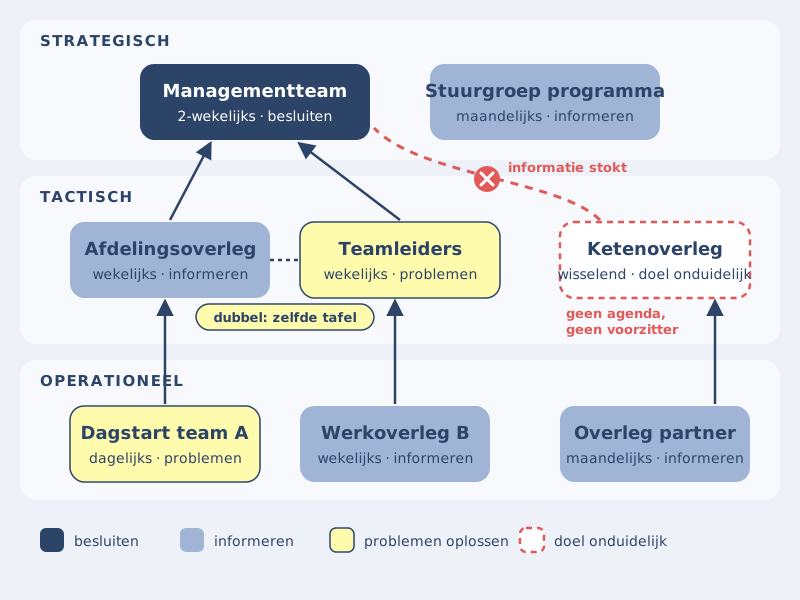
We start with the meetings as they are now, within a department or in a chain between teams, departments and organisations. Which meetings are there at strategic, tactical and operational level, and how often do they meet? What is the purpose of each meeting: informing, deciding, solving problems or something else? And who attends, who chairs, is there an agenda and is it followed?
That gives a picture of where information gets stuck, where meetings duplicate each other and where decisions are never made.
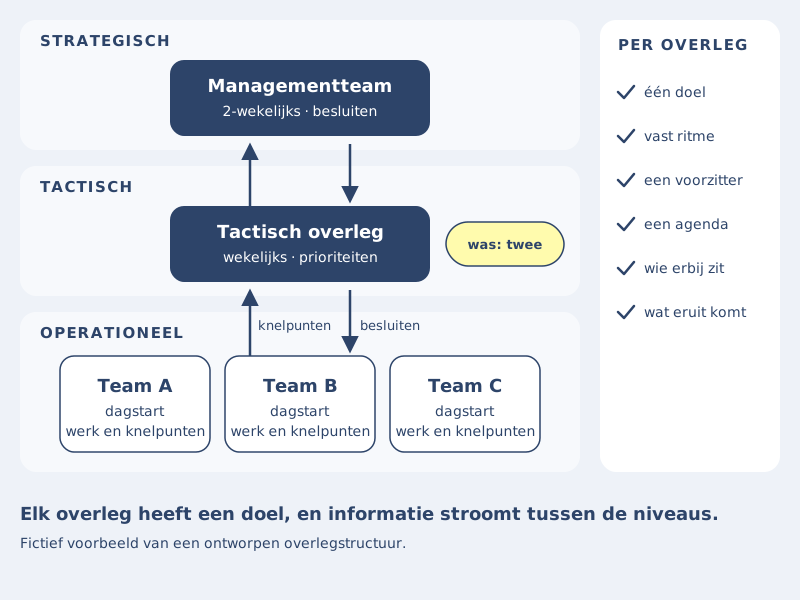
A meeting only works if the people who have to make the decisions there also have the mandate to do so. That is why we design the meeting structure on the basis of the agreements on roles and mandates.
Then we design together a meeting structure that suits your organisation: which meeting there is for which purpose, who attends, how often, and how information gets from one level to the next.
Sometimes the question is strategic. At a school board, the meeting with the head teachers only discussed the schools where things were going badly. We set it up differently: over the year every school is discussed, grouped into green, amber and red, and each time a school that is doing well is on the agenda too. That way the board gets a picture of the whole organisation, and the schools quietly struggling on alone come into view as well.
When this helps
When meetings take a lot of time and deliver little, when the same topics come up at several tables, or when information gets stuck between teams or organisations.
What you get
- A picture of all meetings per level, with purpose, frequency and participants
- A view of where information gets stuck and which meetings duplicate each other
- A meeting structure that suits your organisation
- For each meeting a purpose, an agenda and a chair
Background: Structure
Setting up portfolio and capacity managementA view of all projects: what is mandatory, what the organisation asks for and which innovations are possible. With a roadmap that fits what teams can handle.
When many projects are running, it is often unclear how they relate to each other, who leads them and what they aim to achieve. Portfolio management helps to keep an overview across all projects, and sometimes to say goodbye to projects that do not contribute to the goals. It is also important to understand better which departments or people spend how much time on what. After all, you can only spend each hour once. A clear view of your capacity, and of what is asked of it, helps with that.
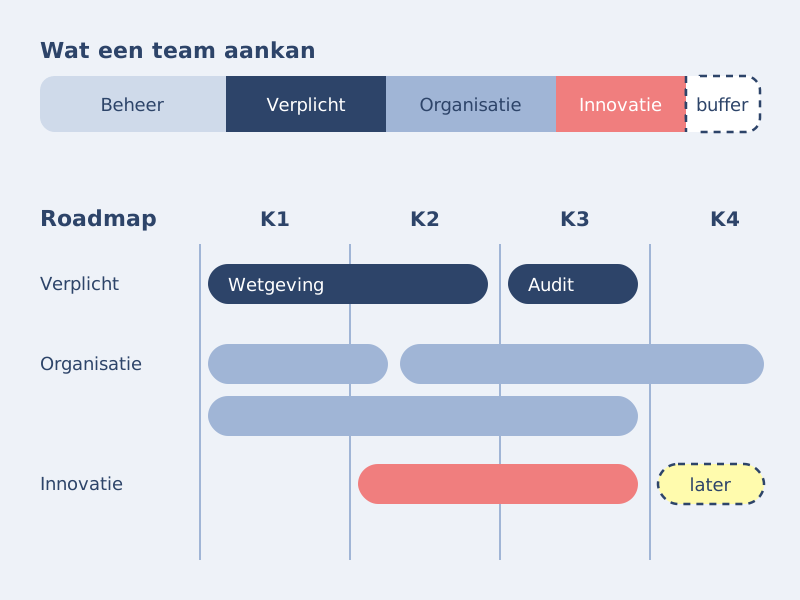
Often there is a long list of projects, wishes and changes, and decisions about the same people are made in several places. Whoever shouts loudest gets priority, and more is promised than delivered.
We start with an inventory per team in one Excel sheet: what is already known is in it, and the team adds what we don’t know, such as the status, the size and when it runs. Anything duplicated or lapsed comes off.
Then we sort: what is mandatory because of legislation or compliance, what the organisation asks for and which innovations are possible. You cannot choose to drop mandatory work, only schedule it. You decide on the rest together: what now, what later and what not at all.
Together with capacity management, we make visible what teams can handle. That produces a roadmap for the coming quarters or the coming year that fits the available capacity. Process first, then a tool: a good overview is often enough to start with.
A grip on the work you have to do, in service of where you want to go. You see per quarter whether the work you want to do fits the time your team has.
Capacity management is about getting a grip on the work: do you know what is coming the team’s way, and does it contribute to the goals and the direction? You only know what is being asked once portfolio management is in place. That is where all the work sits on one list, with the size of each initiative and the quarter or term in which it runs.
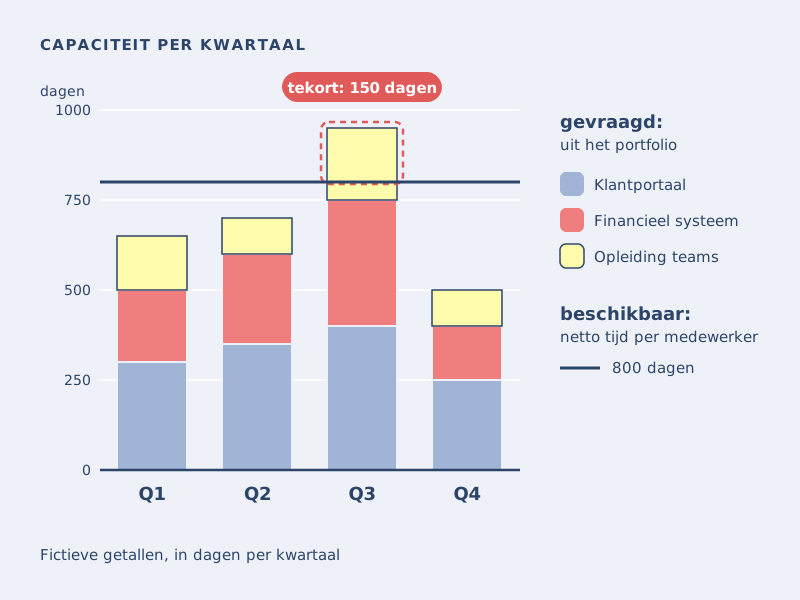
We also calculate what is available: per employee the time that is really left for that work, after operations, regular meetings and a realistic factor for leave and sickness.
Linking the two shows you per quarter, and where needed per week, whether the work fits. Often there is enough time in total, but not at the right moment. Then you make a deliberate choice: move a start date, bring in temporary help or drop something that contributes less to the direction.
When this helps
When there is more on the list than teams can handle, priorities change halfway through, or nobody can explain why something does or doesn’t happen. Portfolio management helps you promise less and finish more. When projects keep overrunning and the team says it is full, but nobody can show how full. Or when there is an annual plan and you want to know whether it is achievable.
What you get
- One overview of all projects, wishes and changes
- A division into mandatory work, wishes of the organisation and innovations
- A fixed way of choosing, with one entry point for new requests
- A roadmap per quarter that fits what teams can handle
- One picture of required and available capacity per quarter or term
- Net available time per employee
- The periods with a shortfall, well in advance
- Choices in the portfolio based on what the team can handle
Background: Structure
| A | B | C | D | E | F | G | |
|---|---|---|---|---|---|---|---|
| 1 | ID | Initiative | Type of work | Status | Size | Start | End |
| 2 | P-01 | New onboarding route | D · own project | In progress | M | Q1 | Q3 |
| 3 | P-02 | New law on flexible workers | B · mandatory | Not started | M | Q1 | Q2 |
| 4 | P-03 | Renew absence policy | D · own project | Not started | L | Q2 | Q4 |
| 5 | P-04 | Convert reports | B · mandatory | In progress | S | Q1 | Q1 |
| 6 | P-05 | Gifts policy | D · own project | Duplicate, see P-06 | |||
| 7 | P-06 | Expenses and gifts policy | D · own project | Not started | M | Q2 | Q3 |
| 8 | P-07 | Working group from 2024 | D · own project | Lapsed, can go | |||
| 9 | P-08 | HR support for new building | C · organisation | In progress | L | Q1 | Q4 |
| A | B | C | D | E | |
|---|---|---|---|---|---|
| 1 | Roadmap 2027 | Q1 | Q2 | Q3 | Q4 |
| 2 | Initiatives | 4 | 5 | 4 | 2 |
| 3 | Indicative days | 33 | 53 | 43 | 26 |
| 4 |
For each team, everything on the table, gathered from every list.
| A | B | C | D | E | F | |
|---|---|---|---|---|---|---|
| 1 | Employee | Contract h/wk | Operations h/wk | Meetings h/wk | Factor | Net h/wk |
| 2 | Employee A | 36 | 6 | 4 | 0.85 | 22.1 |
| 3 | Employee B | 24 | 12 | 4 | 0.85 | 6.8 |
| 4 | Employee C | 24 | 2 | 4 | 0.85 | 15.3 |
| 5 | Employee D | 32 | 10 | 4 | 0.85 | 15.3 |
| 6 | Employee E | 36 | 12 | 4 | 0.85 | 17 |
| 7 | Team total | 77 |
| A | B | C | D | E | F | G | H | I | J | K | L | M | |
|---|---|---|---|---|---|---|---|---|---|---|---|---|---|
| 1 | Week | 41 | 42 | 43 | 44 | 45 | 46 | 47 | 48 | 49 | 50 | 51 | 52 |
| 2 | Available | 37 | 37 | 35 | 33 | 33 | 39 | 41 | 41 | 43 | 43 | 47 | 20 |
| 3 | Project demand | 20 | 30 | 40 | 40 | 45 | 45 | 40 | 35 | 30 | 30 | 25 | 10 |
| 4 | Balance | 17 | 7 | -5 | -7 | -12 | -6 | 1 | 6 | 13 | 13 | 22 | 10 |
First per employee: how much time is left for projects?
Using technology and automation to organise work smarterLess retyping, chasing and waiting for approval. Systems and AI take over the manual work that is left: forms that are complete at the source, links instead of retyping, and approvals that go to the right person automatically.
We only start once the process has been redesigned and the waste has been removed. Otherwise you automate the detours as well.
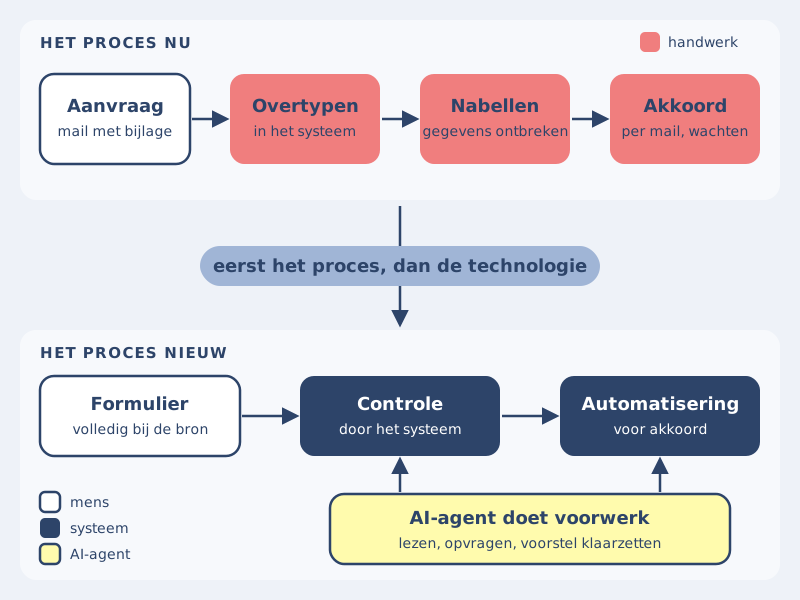
Then we look at each step to see what the system can take over. A form that can only be sent once it is complete, a link so that nobody retypes anything any more, automation in the system that puts an approval in front of the right person. And where it fits, an AI agent that does the groundwork: reading a request, asking for missing data, preparing a proposal.
We prefer to build with what you already have, such as the automation in your own systems. A person always makes the decision, and we agree which data an AI agent may and may not use.
When this helps
When the process has been cleaned up and there is still retyping, chasing or waiting for an approval by email.
What you get
- For each process step a choice: manual, automation in the system or AI
- A first working automation in your own systems
- Agreements on what an AI agent may do and who decides
- A measurement of the time it saves
Background: Process optimisation
What we do in practice
Grow people
Drawing on people’s strengths to take the organisation further.
New plans, processes and structures only change an organisation once people start working with them. That is why we work with directors and managers, and with the people who do the work. They know what is going on, what works and where things rub. We use that knowledge to find solutions together that fit everyday practice.
We do this as equals and partners, paying attention to different perspectives, relationships and the balance between them. We make room for dialogue, including when things get tense or interests clash. People help investigate, design and carry out the change themselves.
We know how behaviour, culture and group dynamics move an organisation forward or hold it back. We put unwritten rules and recurring patterns on the table, tackle what is going on between people, and develop leadership, ownership and professional collaboration. That way people grow in what they can do, and in how they work and learn together.
How we have tackled this before
Click an example to see how we tackled it, what it delivered and what it takes.
Developing culture and a professional way of workingWe work with management and teams on the behaviour that fits your goals, so that the culture moves with where you want to go.
You don’t change a culture with a presentation. We work with management and teams on the behaviour that fits the goals, and start with how things really go here: which unwritten rules apply, and what do people only say after the meeting?
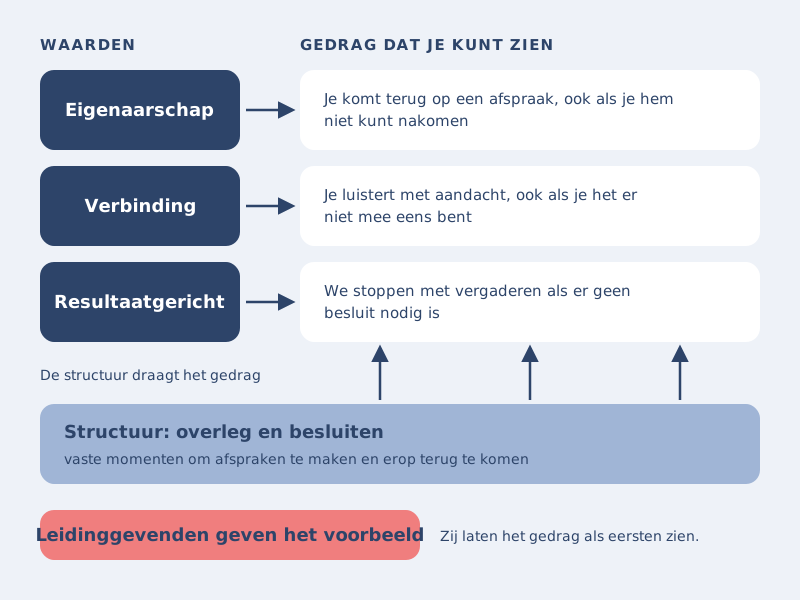
Then we translate the values into behaviour you can see, with agreements that teams make themselves. Managers have a role of their own in this: they set the example, and we support them in doing so.
At the same time we look at how meetings and decisions are organised. New behaviour doesn’t last in a structure that rewards the old.
Sharpening the direction together and turning it into goals that teams recognise in their own work.
We sharpen the direction with the people who have to make it happen. What do we want to achieve, and why? We work appreciatively and start with moments when the organisation was at its best.
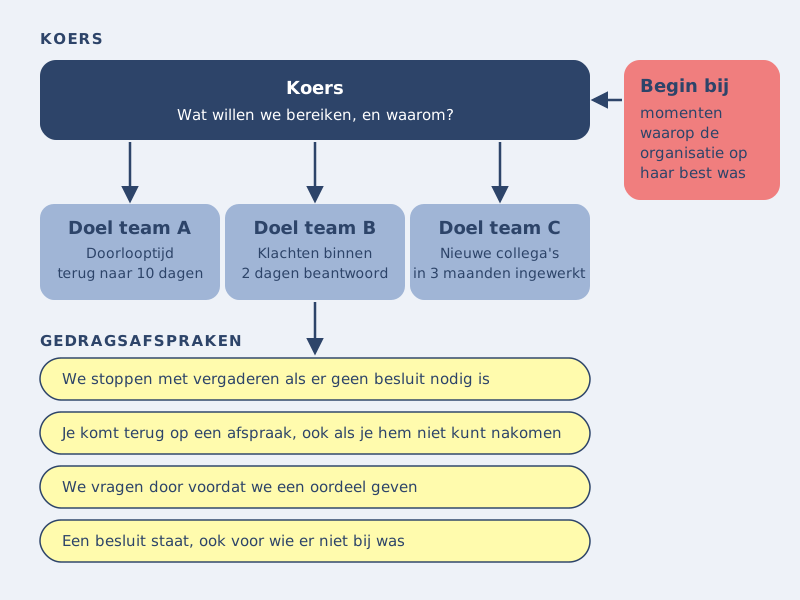
Then we translate the direction into goals per team and into behaviour. What does this mean for how we meet and decide? Which behaviour do we want to see more often, and what do we no longer accept as normal?
The result is a direction that teams recognise in their own work, with agreements you can hold each other to.
When this helps
When you are working towards a new direction and behaviour isn’t keeping up, or when two ways of working carry on side by side after a merger or reorganisation. When there is a vision on paper that makes little difference on the shop floor, or when there are lots of separate initiatives that don’t hang together.
What you get
- A picture of the current culture, discussed with the people themselves
- Values translated into behaviour you can see
- Managers who set the example
- Structure and culture that reinforce each other
- A direction you can explain in a few sentences
- Goals per team that go with that direction
- Agreements on behaviour in the team’s own words
- A first step for each team
Background: Psychological safety
Team development and team coachingWe support a team whose collaboration has got stuck, right in the work itself. That way the team members learn from one another and the effect lasts.
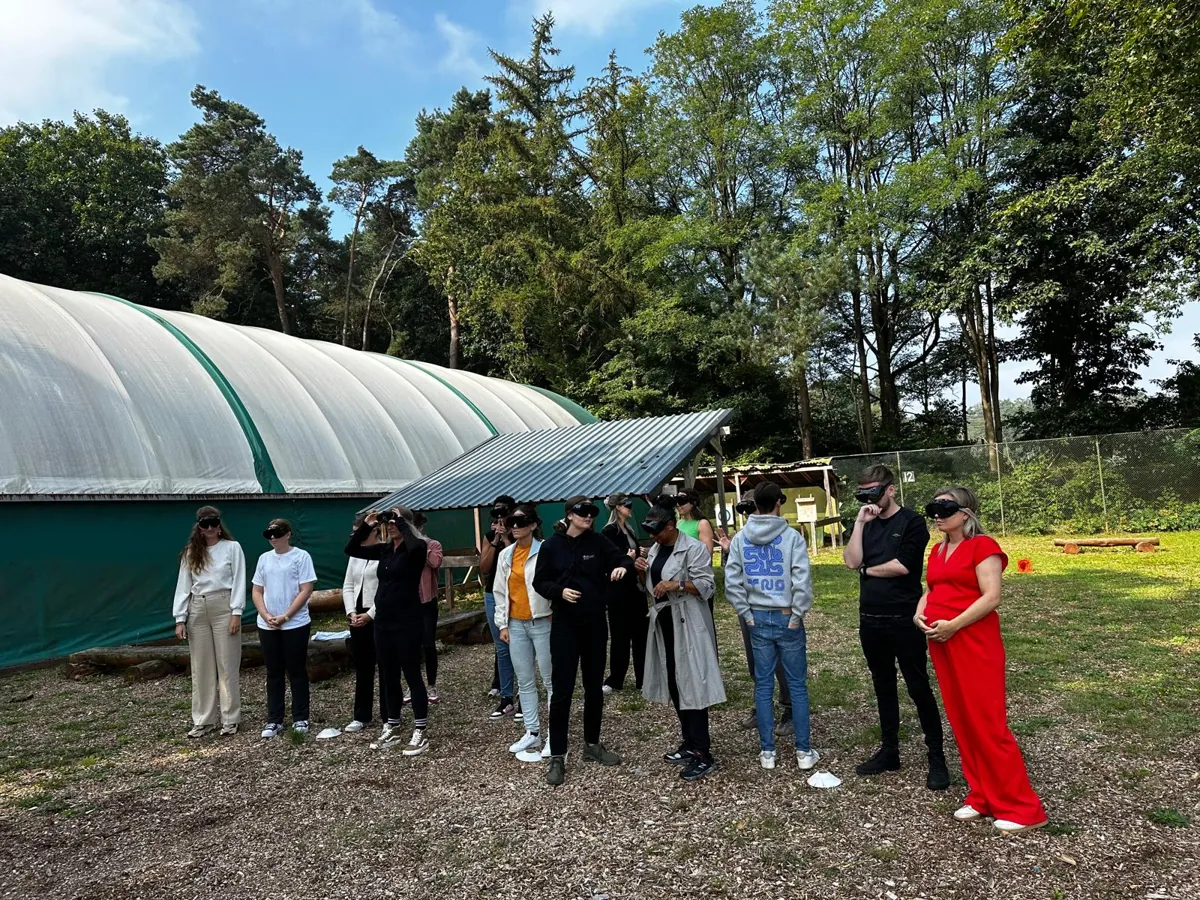
We support the team in the work itself: in the meeting, on a team day or at a difficult moment. That way the team practises the conversation it would otherwise avoid, right where it is needed.
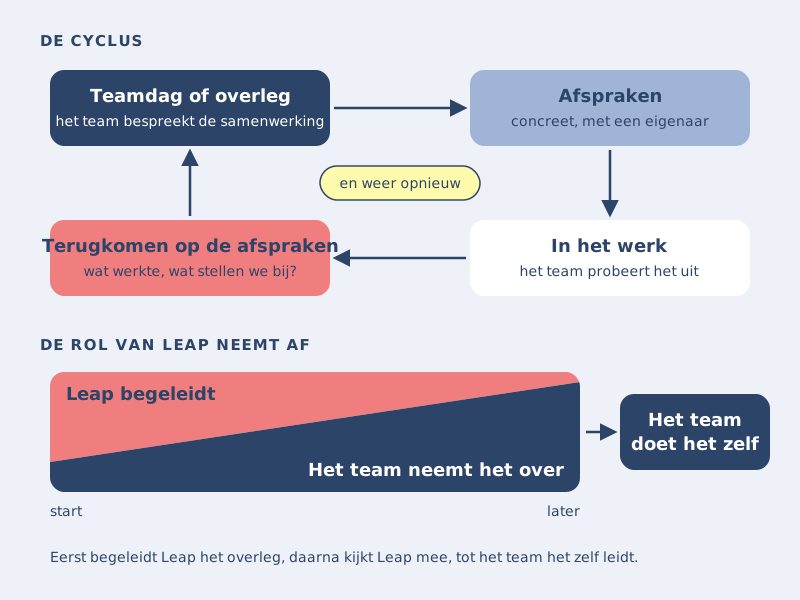
On a team day we handle the set-up and lead the conversation, and we slow things down where it gets tense. That way everyone can take part instead of organising, including the manager.
Between sessions the team comes back to the agreements it made. Our work is done when the team does that without us.
When this helps
When a team’s collaboration gets stuck, when there is a change of leadership or direction, or when something is going on that nobody can yet put their finger on.
What you get
- A team that has the difficult conversation itself
- Agreements on collaboration that stick
- A team day that leads to choices
- A manager who can take part
Background: Psychological safety
Strengthening ownership and psychological safetyA workshop that brings out what everyone feels and nobody says. A bit of humour makes it easier to raise sensitive topics.
In a workshop we make visible which rules apply without anyone having written them down. Who takes the floor, what happens with a mistake, what is only said after the meeting? We first look at what is there, before we try to solve anything.
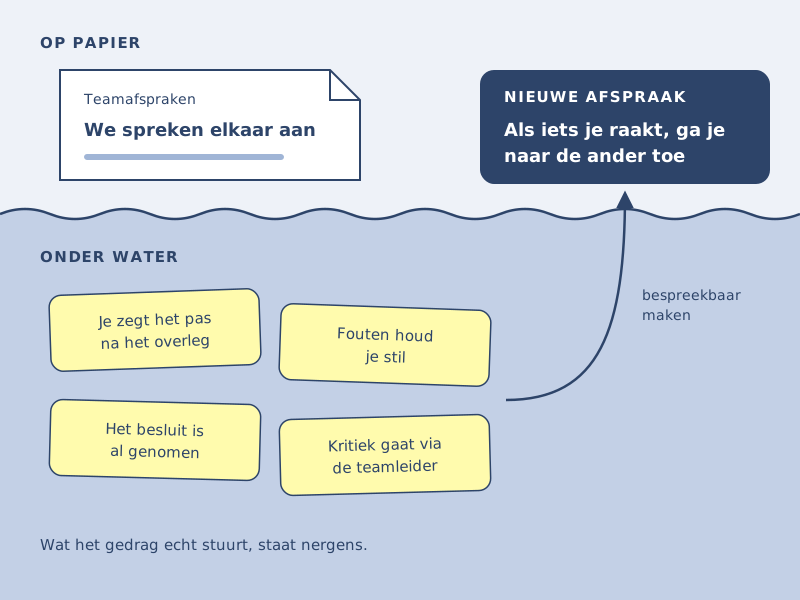
Then we set those rules against the vision and values of the organisation. Where they clash, the team agrees what it will do from now on. For one team that became: if something bothers you, you go to the other person and not to the manager.
The agreements get a fixed slot in the team meeting, so the team keeps them up to date itself.
When this helps
When it says on paper that you hold each other to account, but everyone knows that is not how it works. Or when changes keep running aground and nobody can say why.
What you get
- The team’s unwritten rules, spoken out loud
- Agreements on behaviour that the team makes itself
- A fixed slot in the meeting to come back to them
- More room to hold each other to account
Background: Psychological safety
Developing professional dialogue and collaborationWe bring together the parties involved in a challenge and facilitate the conversation. Where views differ, the conversation that matters begins.
We first map who is involved in the challenge and what they consider important, including the parties who have not been at the table so far.
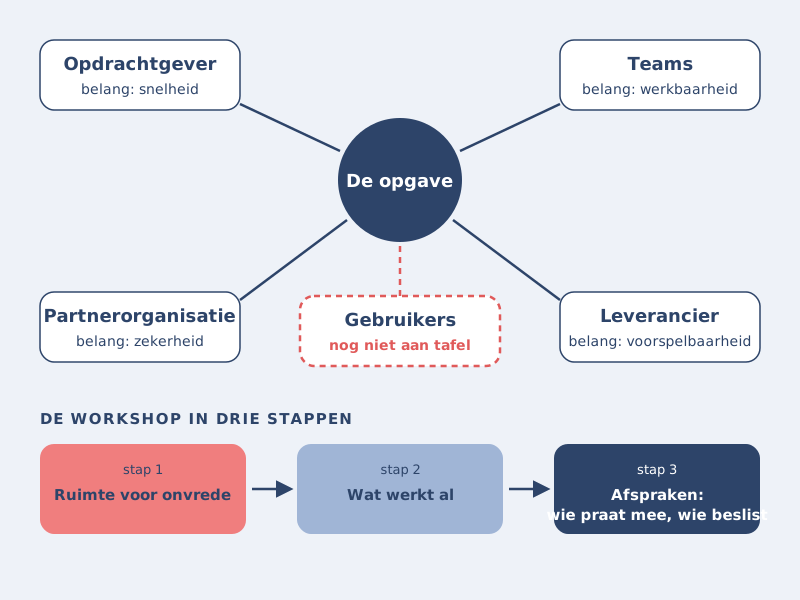
In the workshop we put the different views side by side. Any dissatisfaction gets room first; only then do we turn to the content. We work appreciatively: we start with what already works and where those involved want to go together.
The result is a shared picture of the challenge, with agreements on who has a say in what and who decides.
A change succeeds when people come along with it. We involve the people it affects and work with colleagues who champion the change in their own team.
We first look at who the change affects and what it means for them. Then we look in the organisation for people who want to help: colleagues who explain the change, gather questions and show how it can work in their team.
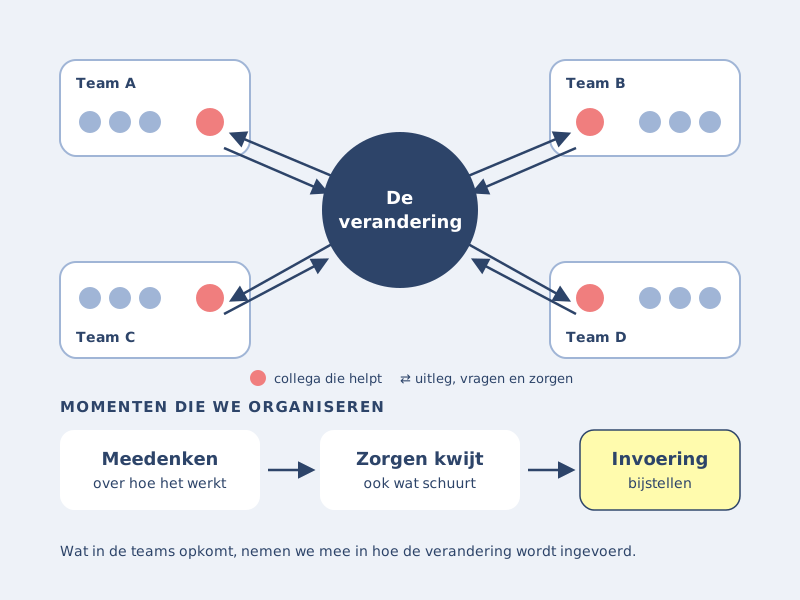
With them and with management we organise moments when people can think along and voice their concerns. We take what comes up into account in how the change is introduced.
When this helps
When several parties are working on a challenge together and it turns into a tug of war, or when a group that is affected has not yet been heard. When a reorganisation, merger or new way of working is coming, or when an earlier change stalled because people did not come along.
What you get
- An overview of those involved and their interests
- A shared picture of the challenge
- Agreements on who has a say and who decides
- Support among the parties affected
Background: Appreciative inquiry
Designing and running training, workshops and development programmesSometimes a training course, a workshop or a development programme is exactly what is needed. We design it for your question and run it ourselves.
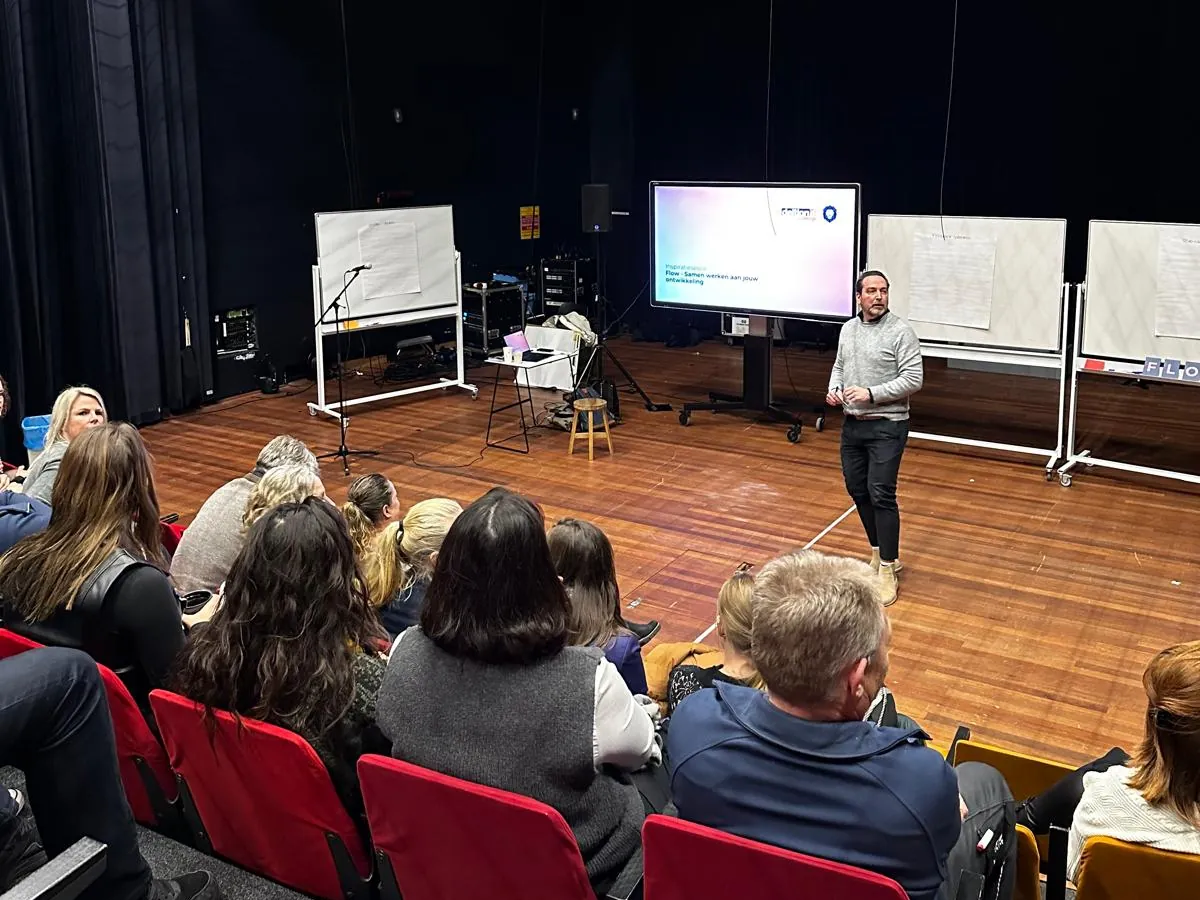
Sometimes a training course, a workshop or a development programme is exactly what is needed. We design it for your question, with your own situations as practice material, and run it ourselves.
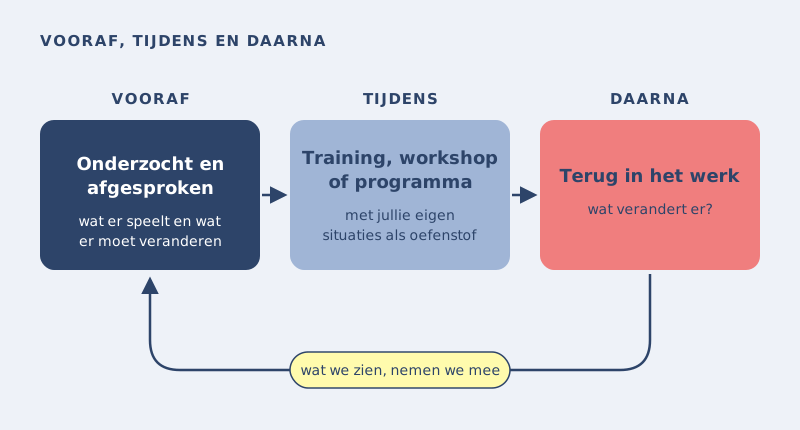
A training course like this never stands alone. It builds on what we have investigated and agreed together beforehand, and afterwards we look at what it changes in the work.
When this helps
When it is clear what needs to happen and people need to learn or practise something new for it.
Innovative tools.
Smart technology for sharper insight and faster development.
We combine our expertise in organisations and people with smart technology, so we spot patterns sooner and make complex issues easier to grasp. We use existing tools, and build our own applications when they make the work smarter and more effective.
For example, we use Leapshift, our Governance app and ESCI 360 to develop organisations and people in a more targeted way.
Our tools never stand alone. They support our approach, enrich the conversation and help turn insights into solutions that work in practice.
Our approach in practice.
A culture issue that turned out to be about more than culture
A department wanted a more professional working culture. But where do you start? With a training course, new agreements on behaviour, or team development?
Dig deep
We started with an organisational diagnosis and interviewed people from across the department. It turned out that the issue was not just about behaviour. Unclear decision-making, responsibilities and mandates made it hard for people to take professional ownership.
Organise smart
So we started by tightening up decision-making, and left team development for later. Who is responsible for what? Who gets to decide what? And within which limits? Our Governance app quickly mapped the different views, which got us to clear agreements sooner.
Grow people
Clear agreements are only half the job. Next, people have to practise the new behaviour. For employees, that means taking responsibility, finding the courage to do so, and holding each other to account in a professional way. For managers, it means giving people room and trusting the agreements made.
It all hangs together. What began as a question about professional culture first needed clarity in the organisation’s structure. That clarity is what made it possible to work on behaviour and ownership afterwards.
Wondering if we’ll click?
Fine words are no use if the chemistry isn’t there. Let’s get to know each other first and see what you need.
Prefer to call? Laura +31 6 2717 3742 or Maarten +31 6 5107 2929.
You’ll get a confirmation by email shortly, and we’ll be in touch.